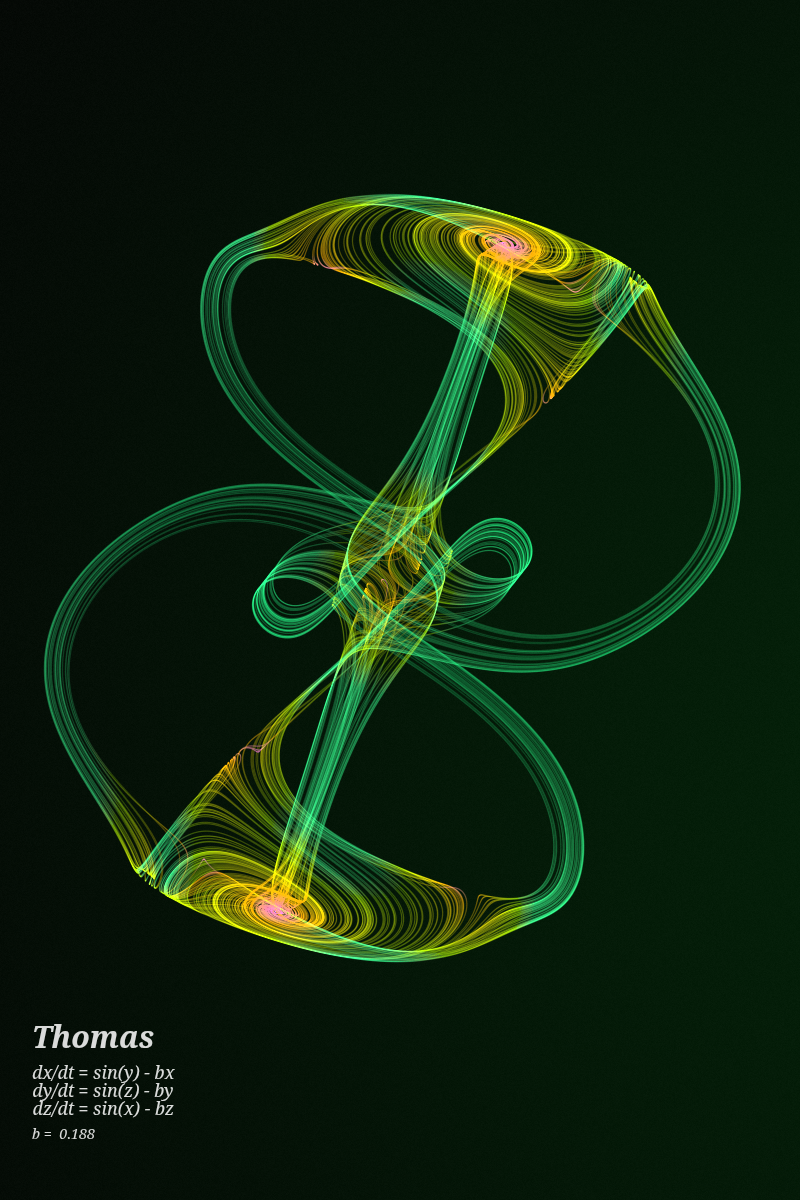
Overview
Proposed in 1999 by Belgian molecular biologist and cyberneticist René Thomas, this deceptively simple system of differential equations models friction-damped motion through a periodic three-dimensional force field.
Thomas was investigating feedback loops and cyclic networks in gene regulation, searching for the simplest differential equations that could sustain continuous deterministic chaos. The result is a mathematically minimal masterpiece characterized by pure cyclic symmetry: every equation is an exact cyclical permutation of the other two ().
The Mathematical Model
The Thomas system uses sinusoidal driving forces balanced against linear dissipation:
Here, acts as a damping or friction parameter:
- : The system possesses stable equilibrium points; all trajectories eventually slow down and converge to rest.
- : The system undergoes a bifurcation into deterministic chaos.
- : The system approaches a conservative (Hamiltonian) flow, generating an infinite, space-filling labyrinth.
Topological Characteristics
- Infinite Labyrinth: Because the non-linear terms are periodic trigonometric functions (), the vector field repeats across three-dimensional space, giving rise to interconnected tubes and chambers through which the particle wanders chaotically.
- Cyclic Isometry: Rotating any state by around the diagonal axis maps the attractor precisely onto itself.
- Organic Weave: In long-exposure particle renderings, the Thomas attractor resembles a dense bundle of woven, glowing silk ribbons that curve gracefully around cubic cells without ever self-intersecting.