Overview
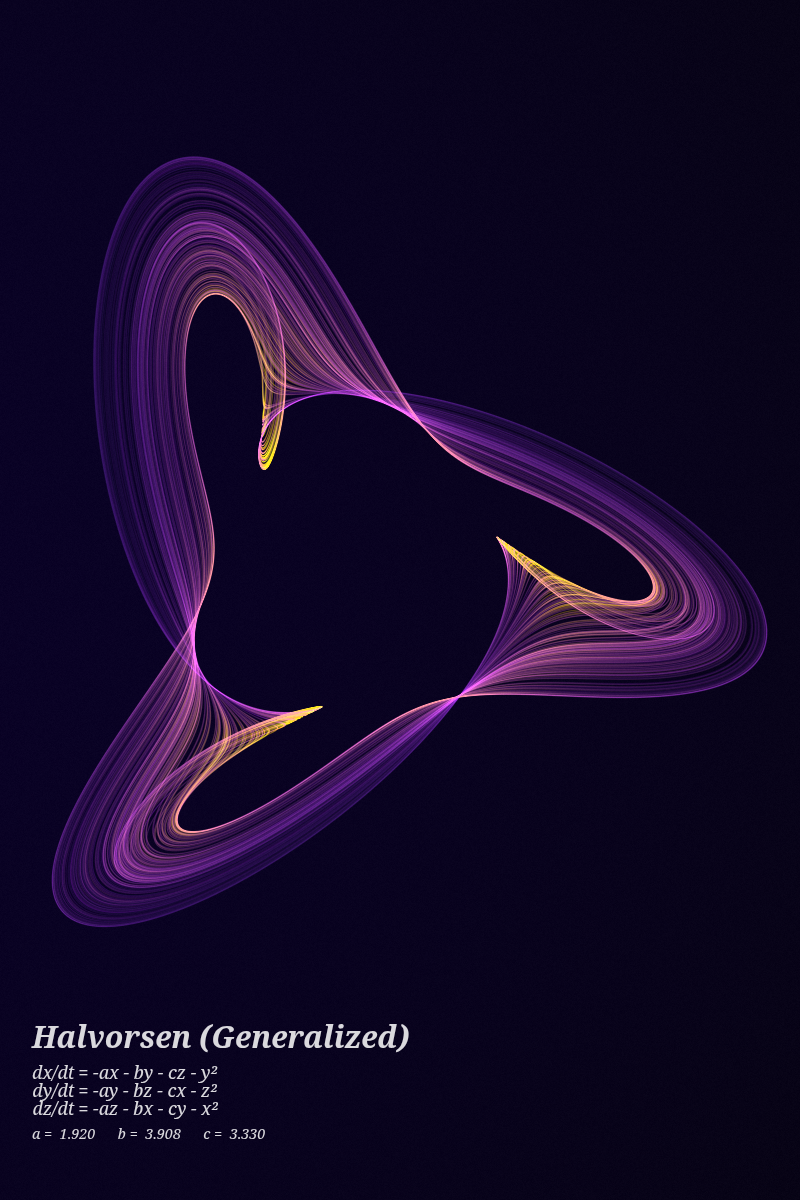
Discovered by Danish scientist Christoffer Halvorsen in the early 1990s, the Halvorsen attractor is renowned for its graceful cyclic symmetry. The system features a threefold rotational symmetry around the main diagonal axis ().
Rather than the dual-wing topology of the Lorenz system, the Halvorsen attractor features three distinct aerodynamic lobes arranged symmetrically in space like the petals of an exotic flower or a Celtic trefoil knot.
The Mathematical Model
The Halvorsen attractor is defined by three symmetrically coupled differential equations with quadratic non-linearities:
Dynamics
The quadratic terms provide the non-linear folding mechanism essential for chaos, while the linear cross-coupling terms drive cyclic circulation between the three lobes.
Geometric Hallmarks
- Threefold Symmetry (): The equations are invariant under the cyclic permutation . This generates three identical curved lobes rotated by around the axis .
- Chaotic Leaping: Trajectories orbit within one lobe in widening spirals until centrifugal acceleration flings the point toward the central saddle point, launching it into one of the remaining two lobes unpredictably.
- Volumetric Ribboning: In our WebGL visualizer, millions of particle trajectories trace the Halvorsen system to reveal translucent ribbons with clean edges and delicate density striations.