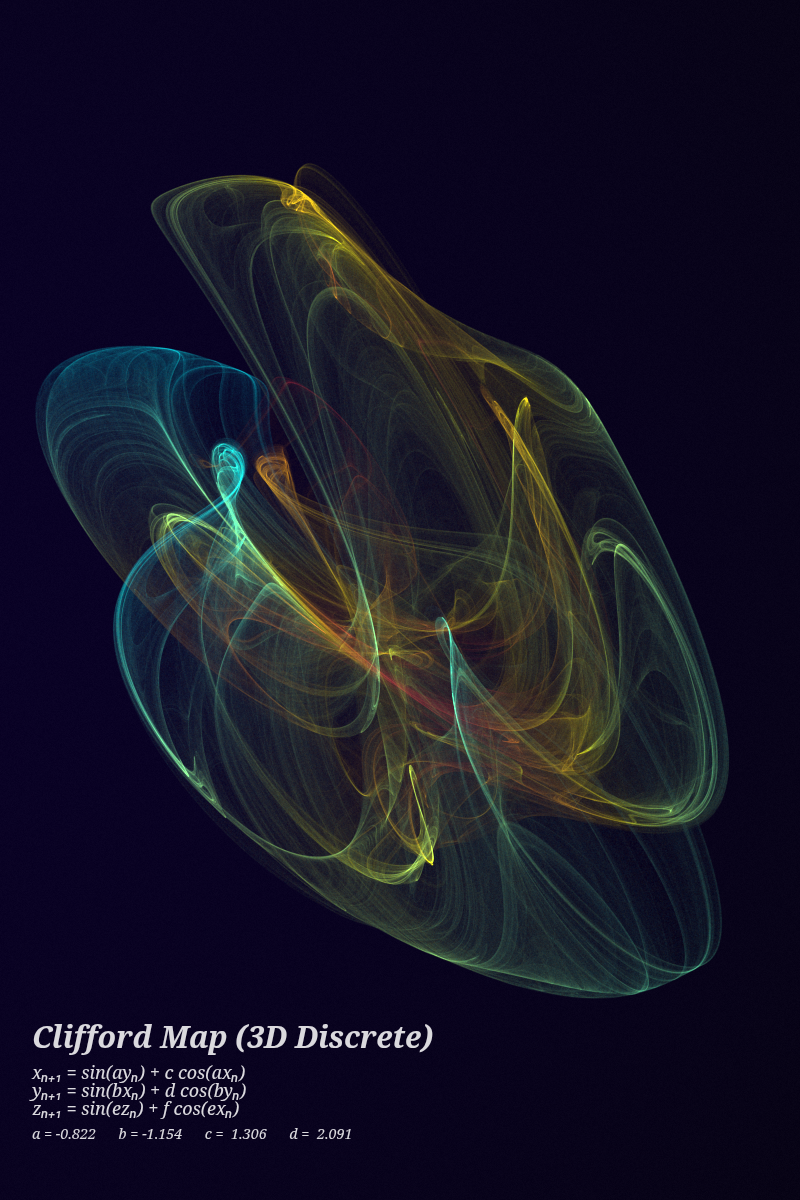
Overview
Formulated by prolific author, inventor, and mathematician Clifford A. Pickover in his groundbreaking work Computers, Pattern, Chaos, and Beauty (1990), the Clifford Attractor is an iterated discrete dynamical system rather than a continuous flow of differential equations.
Instead of tracking continuous smooth trajectories, discrete maps evaluate algebraic recurrences step-by-step: each new coordinate is calculated directly from trigonometric combinations of the prior point . When millions of discrete points are rendered with progressive accumulation, they reveal ethereal, smoke-like sheets that look like folded silk or gravitational lensing.
The Mathematical Model
In 3D phase space, the Clifford recurrence relation is defined by:
Why Trigonometric Iterations Create Chaos
Because and are bounded between and , the coordinates can never escape to infinity. The nonlinear folding compresses the space, while the trigonometric angular sensitivity stretches adjacent points apart at an exponential rate. The interplay of stretching and folding within bounded limits is the fundamental recipe for strange attractors.
Aesthetic & Structural Features
- Filamentous Layers: Rather than single strands, Clifford attractors produce multi-layered 2D manifolds crumpled into 3D volume.
- Caustic Brightness: Denser regions where multiple folds overlap create radiant caustics reminiscent of sunlight refracted through moving water.
- Parametric Sensitivity: Micro-adjustments to parameters morph the structure from billowing gaseous wisps into intricate cellular filigrees.