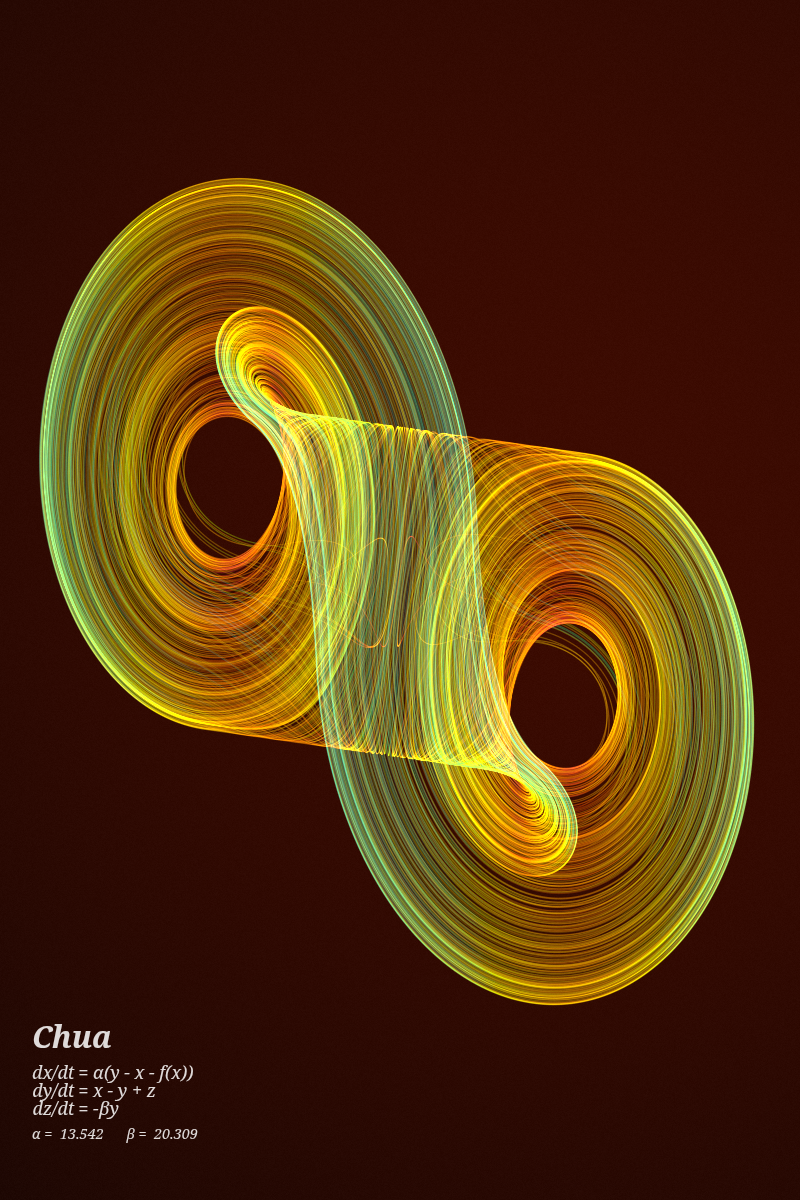
Overview
In 1983, professor Leon O. Chua at UC Berkeley proved that deterministic chaos was not just an abstract mathematical curiosity: it could be physically constructed using standard, off-the-shelf electronic components.
Chua’s circuit consists of four standard linear elements (two capacitors, an inductor, and a resistor) connected to a single active non-linear resistor, known universally today as Chua’s diode. The circuit generates electrical voltages and currents that fluctuate in an endless, non-repeating double-scroll strange attractor.
The Mathematical Model
The state variables correspond to the voltage across capacitor , the voltage across capacitor , and the electric current through the inductor :
The piecewise-linear function models the non-linear negative resistance of Chua’s diode:
The Double-Scroll Phenomenon
- Bistable Spirals: The system possesses three equilibrium points: an unstable saddle at the origin and two symmetric equilibrium points on either side.
- The Double Scroll: Trajectories spiral outwards around one of the equilibrium points until reaching a critical threshold, where they are swept across the origin and captured by the opposite spiral.
- Experimental Verification: Chua’s attractor was the first chaotic system to be rigorously verified mathematically, simulated digitally, and observed in physical laboratory hardware on an oscilloscope.