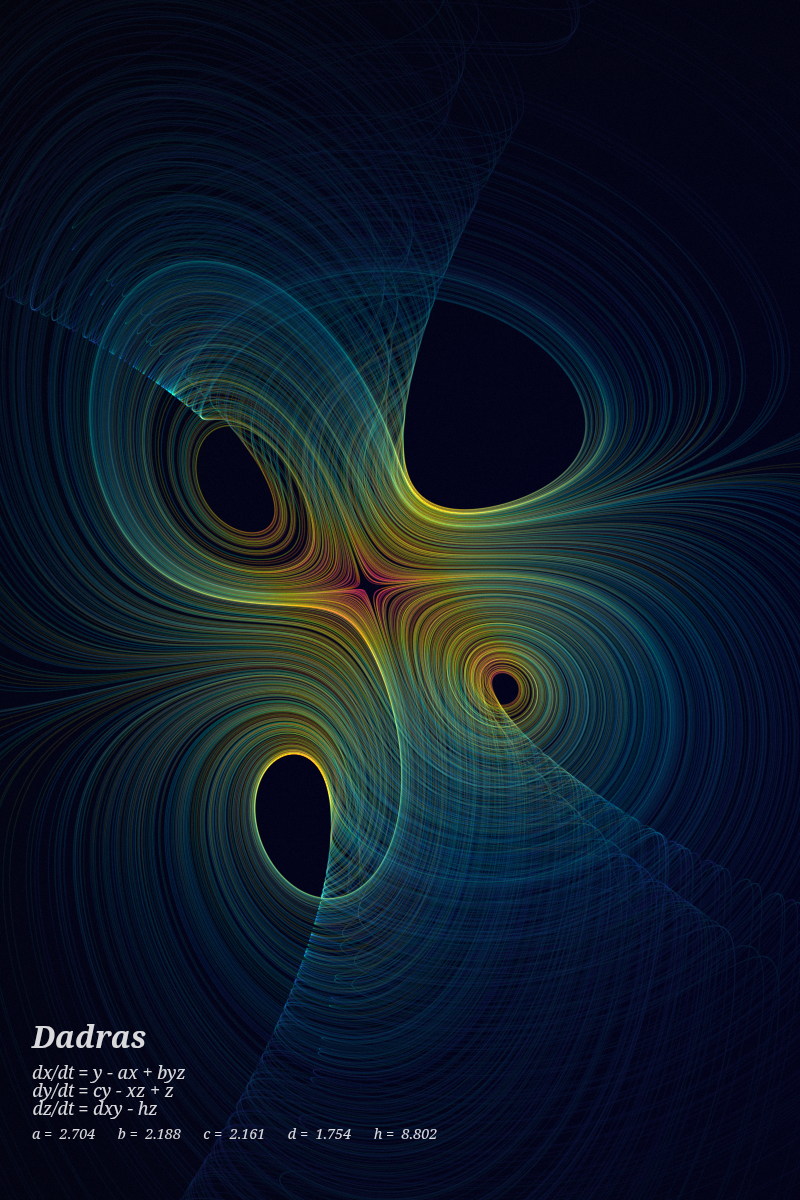
Overview
Introduced in 2009 by researchers Sara Dadras and Hamid Reza Momeni, the Dadras system is a modern five-parameter autonomous chaotic dynamical system. Designed to explore non-standard cross-product non-linearities in control theory and electrical networks, it generates intricate, multi-winged geometric structures.
Unlike classical systems where non-linearities are concentrated in a single cross term (such as or ), the Dadras system incorporates multiplicative cross terms across all three axes ( and ), giving rise to exceptionally rich phase portrait topologies.
The Mathematical Model
The Dadras dynamical equations are:
Dynamic Characteristics
Depending on the parameters , the system exhibits varied multi-scroll behaviors, limit cycles, torus breakdown, and broadband chaotic attractors. The interplay between the and terms forces trajectories to climb into wide, looping orbits before suddenly twisting back into a dense central coil.
Geometric Structure
- Winged Helices: Orbits sweep out broad, aerodynamic ribbons that arch high into phase space before descending through tight vertical pinwheels.
- Multistability: Minor parameter adjustments yield distinct coexisting attractors within different basins of attraction.
- Intricate Caustics: In high-density particle visualizer exports, Dadras forms luminous filigreed curtains with razor-sharp folds.