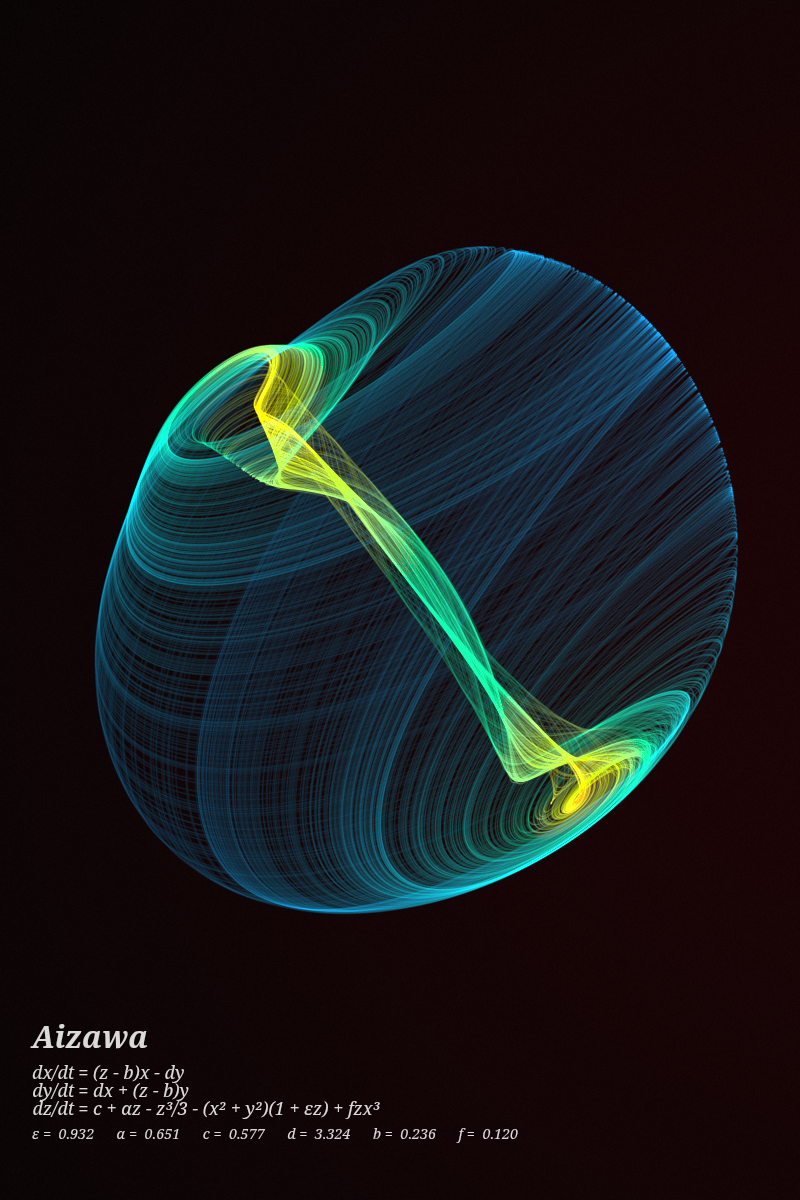
Continuous Dynamical System (ODE) First Described: 1980 Featured Archetype

Aizawa Attractor

Discovered by Yoji Aizawa

Executive Summary

A breathtaking spherical shell featuring a twisting central vortex and delicate chaotic sheet inversions.

System of Equations

Phase Space Formulation
dxdt=(zb)xdy\frac{dx}{dt} = (z - b) x - d y
dydt=dx+(zb)y\frac{dy}{dt} = d x + (z - b) y
dzdt=c+αzz33(x2+y2)(1+ϵz)+fzx3\frac{dz}{dt} = c + \alpha z - \frac{z^3}{3} - (x^2 + y^2)(1 + \epsilon z) + f z x^3

Governing Parameters

ϵ\epsilon
Coupling Nonlinearity = 0.25

Controls the vertical asymmetry and compression of the attractor shell.

α\alpha
Damping / Growth Rate = 0.95

Governs the rate of outward expansion along the z-axis.

bb
Base Height Offset = 0.7

Vertical focal displacement for horizontal rotational oscillations.

cc
Vertical Translation Drive = 0.6

Constant driving upward vertical flow through the core funnel.

dd
Angular Velocity Frequency = 3.5

Determines the rotational frequency of orbits around the central vertical axis.

ff
Cubic Asymmetry Coefficient = 0.1

Generates fine-grained structural warping and broken axial symmetry.

Overview

The Aizawa Attractor was discovered by Japanese physicist Yoji Aizawa during studies on non-linear resonance and chaotic oscillations in 3D dynamical systems. Among mathematical attractors, it is widely revered by generative artists and physicists alike for its organic, balloon-like spherical morphology and vortex-like central core.

Unlike attractors with wide planar lobes like Lorenz or Rössler, the Aizawa attractor winds around a central vertical core, climbing in a dense spiral before turning inward and falling through a hollow central funnel.

The Mathematical Model

The Aizawa system is formulated as a set of three coupled differential equations:

dxdt=(zb)xdy\frac{dx}{dt} = (z - b)x - dy

dydt=dx+(zb)y\frac{dy}{dt} = dx + (z - b)y

dzdt=c+αzz33(x2+y2)(1+ϵz)+fzx3\frac{dz}{dt} = c + \alpha z - \frac{z^3}{3} - (x^2 + y^2)(1 + \epsilon z) + fzx^3

The term (x2+y2)(x^2 + y^2) acts like a radial cylindrical constraint r2r^2. The (zb)(z - b) term produces a height-dependent rotation rate, giving the system its signature swirling vortex profile.

Geometric Structure

  • Spherical Enclosure: The non-linear saturation term z3/3-z^3/3 acts as a cubic restoring force, preventing unbounded explosion and bounding the trajectory inside an elegant droplet-like sphere.
  • Torus Funnel: The trajectory cycles upward along the outer shell, spiraling toward the north pole before plunging down through a hollow inner column back toward the southern basin.
  • Sensitive Swirling: Minute deviations in initial coordinates cause rapid divergence in the timing and radius of consecutive vortex descents, producing dense, iridescent ribbons in 3D renderings.
Previous Type
Lorenz Attractor
All Attractor Types
Next Type
Thomas' Cyclically Symmetric Attractor