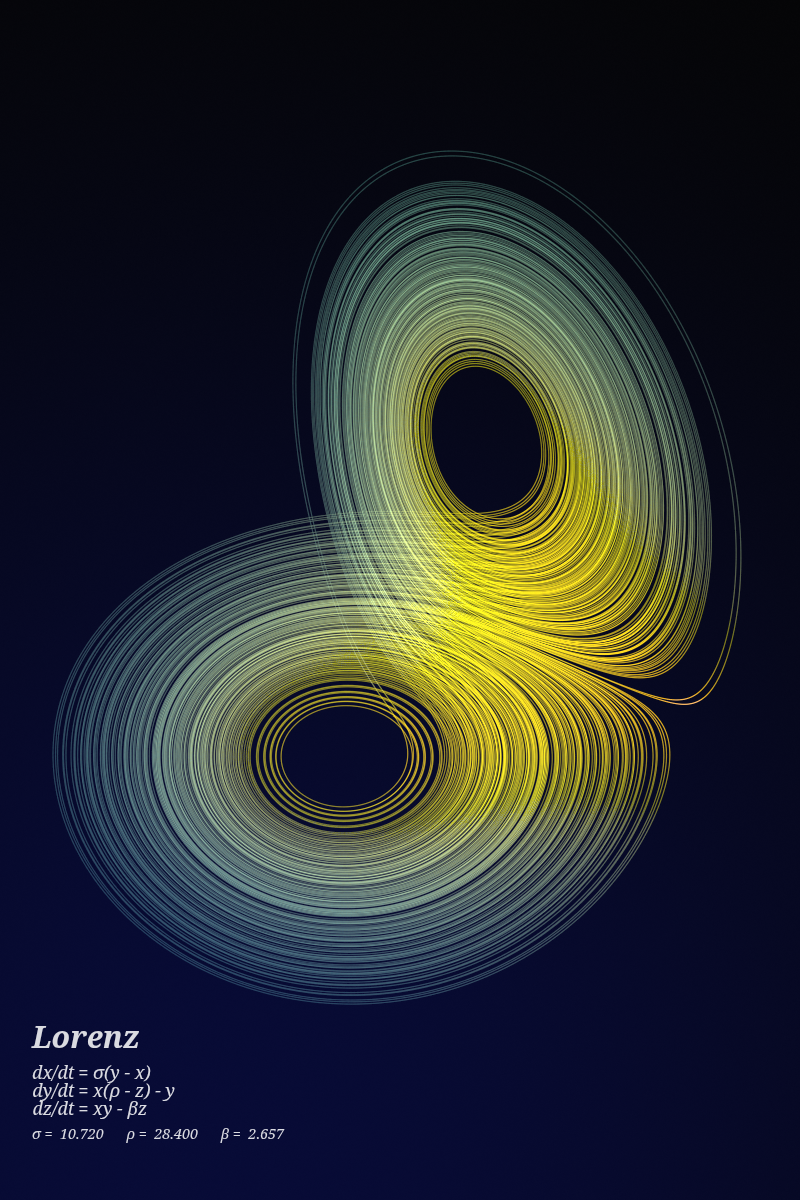
Overview
In 1963, meteorologist and mathematician Edward N. Lorenz was developing a simplified computational model of thermal convection in the atmosphere at MIT. Using a set of 12 non-linear differential equations derived from the Navier-Stokes equations by Barry Saltzman, Lorenz distilled the system down to three coupled first-order differential equations.
When running numerical simulations on a Royal McBee LGP-30 computer, Lorenz stopped a run and restarted it halfway through, typing in initial values rounded to three decimal places (.506) instead of the computer’s internal six decimal places (.506127). To his astonishment, the tiny rounding discrepancy grew exponentially, diverging into a completely unrelated trajectory. This discovery gave rise to modern deterministic chaos and inspired the popular phrase “The Butterfly Effect” — the notion that a flap of a butterfly’s wings in Brazil could set off a tornado in Texas.
The Mathematical Model
The Lorenz system describes a two-dimensional fluid cell warmed from below and cooled from above:
Physical Interpretation of State Variables
- : Proportional to the rate of convective circulation in the fluid layer. Clockwise rotation is positive, counterclockwise is negative.
- : Proportional to the horizontal temperature difference between ascending and descending fluid currents.
- : Proportional to the distortion of the vertical temperature profile from pure linearity (thermal stratification).
Geometry and Chaotic Properties
The Lorenz attractor lives in three-dimensional phase space. Rather than settling into a static point (steady state) or a closed loop (limit cycle), the trajectory orbits indefinitely within a bounded region without ever crossing or repeating its path.
Key dynamical hallmarks include:
- Fractal Dimension: The attractor has a non-integer Hausdorff dimension of approximately 2.06, placing it between a 2D surface and a 3D volume.
- Lyapunov Exponent: The maximum Lyapunov exponent is positive (), proving sensitive dependence on initial conditions.
- Two Strange Lobes: Trajectories spiral outwards on one “wing” until crossing the saddle point between lobes, flipping unpredictably into chaotic spirals on the opposite wing.