Overview
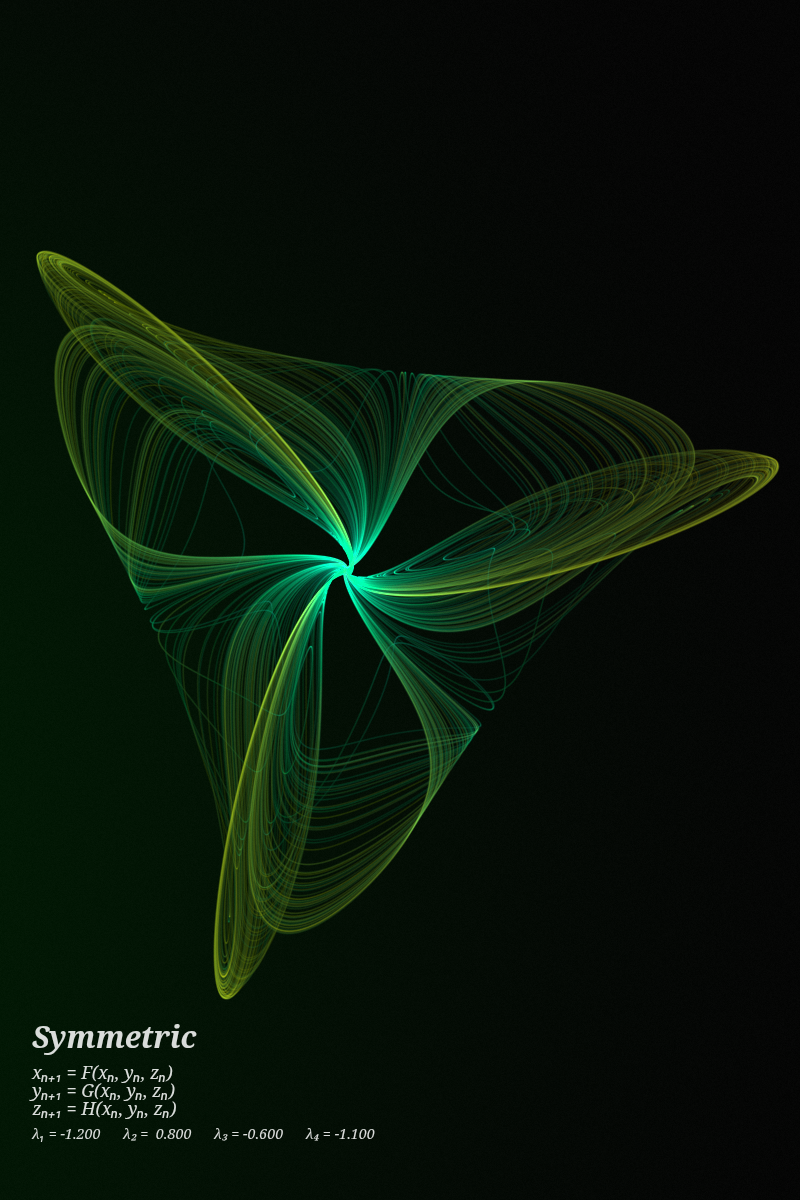
In their classic 1992 treatise Symmetry in Chaos, mathematicians Michael Field and Martin Golubitsky discovered a surprising bridge between two seemingly opposite realms of mathematics: symmetry (rigid, balanced order) and chaos (turbulent, unpredictable disorder).
By constructing dynamical systems that are equivariant with respect to a discrete symmetry group (such as dihedral groups , tetrahedral, or octahedral symmetry), the chaotic trajectories wander unpredictably on a local scale while collectively painting a global pattern of perfect geometric symmetry.
Mathematical Formulation
An iterated map is said to be equivariant with respect to a symmetry group if:
This mathematical constraint ensures that if a chaotic attractor exists, applying any rotation or reflection from group transforms the attractor directly onto itself.
Visual Beauty
- Crystalline Mandalas: In 3D space, symmetric attractors often resemble alien crystals, deep-sea radiolarians, or sacred geometry.
- Uniform Mass Distribution: Because trajectories explore the phase space ergodically, the density of particle strikes averages out to mirror-perfect symmetry across every symmetry axis.
- Dynamic Balance: Individual particle paths jump wildly from lobe to lobe, yet the overall structure remains eternally balanced.