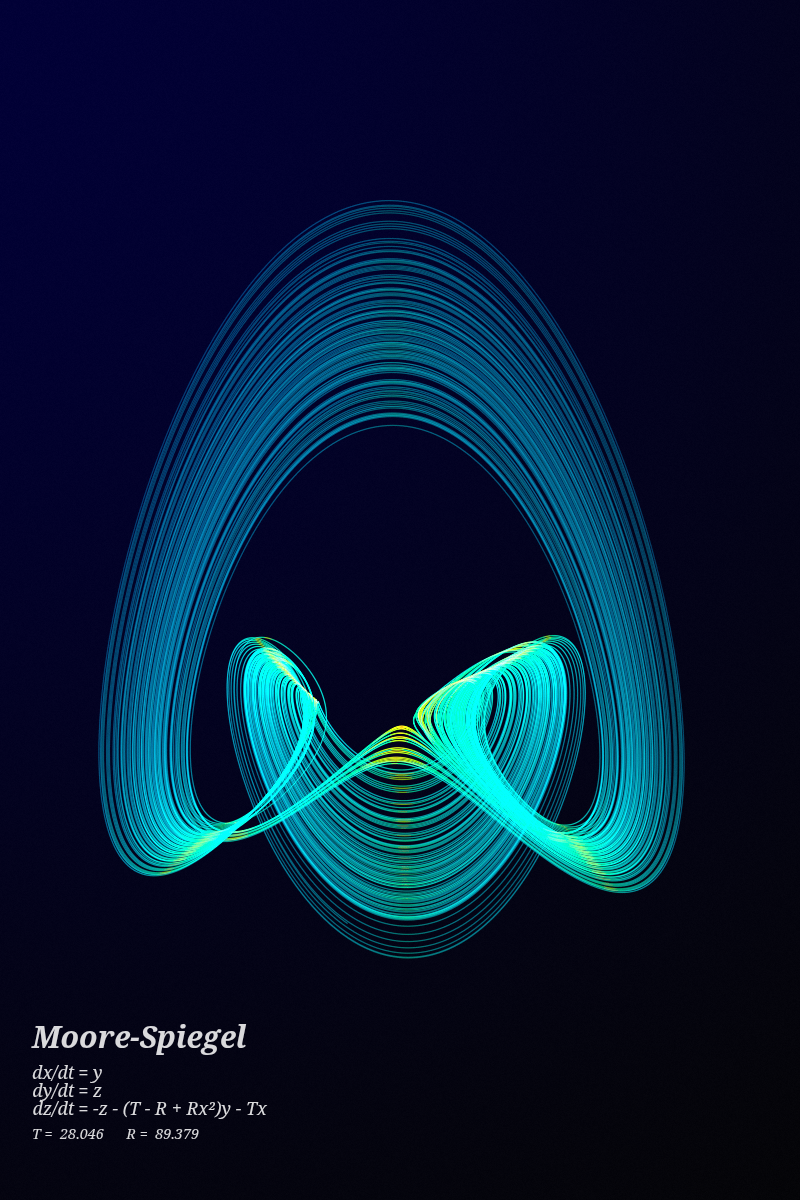
Overview
Proposed in 1966 by astrophysicists Derek W. Moore and Edward A. Spiegel, this third-order differential equation system models the chaotic vertical oscillations of a compressible gas parcel in a variable star’s atmosphere.
In stars undergoing thermodynamic pulsations (such as Cepheid variables or red supergiants), buoyancy forces can destabilize the stellar envelope. As gas rises, it cools and radiates heat away; as it plunges back inward, it heats up and re-expands. Moore and Spiegel proved that non-linear coupling between thermal dissipation and acoustic resonance drives the stellar surface into turbulent, chaotic pulsations.
The Mathematical Model
Represented as a third-order autonomous ODE , rewritten in state-space coordinates :
Coordinates
- : Vertical displacement of the stellar fluid element relative to equilibrium.
- : Radial velocity of the oscillating stellar gas.
- : Acceleration and rate of thermal buoyant energy transfer.
Phase Space Geometry
- Funnel-and-Wave Morphology: The non-linear damping term acts like a Van der Pol oscillator where dissipation depends directly on the square of displacement .
- Explosive Outbursts: The trajectory winds through a tight spiral at small amplitudes before violently expanding outward into wide, sweeping parabolic arcs, mimicking flares and irregular stellar eruptions.